
Blog
Design Hotel WiFi Guests Can Depend On

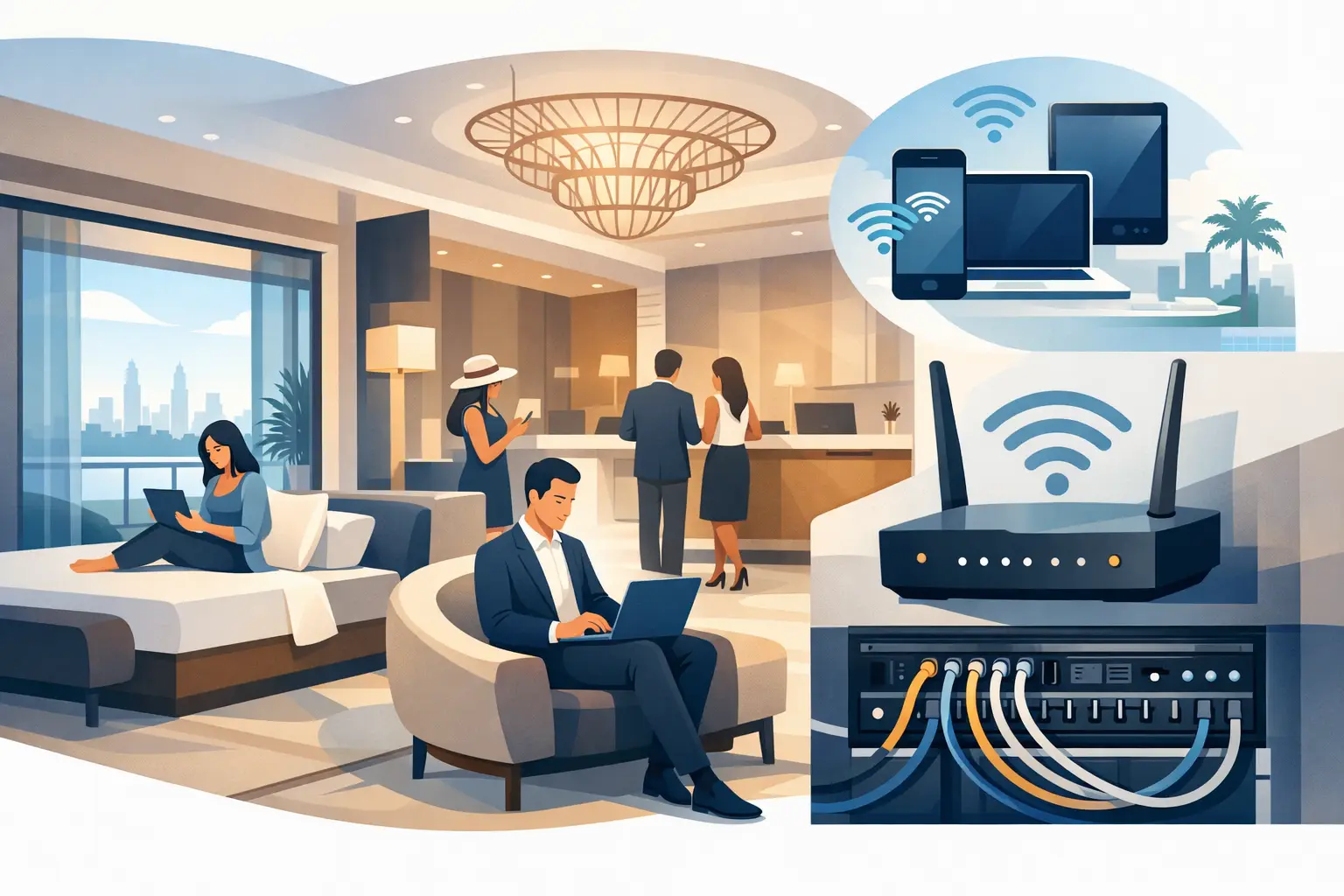
A guest may never see the network rack, wireless controller, or fiber backbone behind a property. They will notice a failed video call, a smart TV that will not connect, or a room-control tablet that stops responding. Design hotel WiFi as core hospitality infrastructure, not as a late-stage amenity, and it supports the entire guest experience as well as daily hotel operations.
For hotel owners, developers, and facilities teams, the requirement is broader than placing access points in corridors. The wireless network must serve guest rooms, public areas, meeting spaces, back-office users, building systems, and staff devices without allowing one group to disrupt another. It also needs to remain manageable after opening, when occupancy patterns, guest expectations, and connected devices change.
Design Hotel WiFi Around Real Use, Not Floor Plans
A floor plan is the starting point, but it is not a wireless design. Concrete slabs, metal framing, decorative wall finishes, mirrors, service shafts, elevators, and mechanical rooms can each affect signal strength and radio performance. In premium hotels, the materials selected for the interior are often exactly the materials that make a simple corridor-based WiFi layout unreliable inside guest rooms.
A proper design begins with a site survey and predictive radio-frequency model. This process identifies where coverage is required, estimates signal loss through construction materials, and determines the appropriate access point locations before ceilings are closed. It should account for both the 2.4 GHz and 5 GHz bands, as well as 6 GHz where the selected system and regional requirements support WiFi 6E or later technologies.
Coverage alone is not the target. A guest may see a full signal indicator while receiving poor performance because too many devices are competing for the same radio channel. Capacity planning considers the likely number of phones, laptops, tablets, streaming devices, and smart-room equipment active at the same time. A business traveler in a standard room has different requirements from a family suite, a ballroom event, or a lobby during peak check-in.
The design should also distinguish between high-density and low-density areas. In a ballroom, many users may connect at once but remain in one open space. In guest-room floors, access points must serve users separated by walls and floors. Those are different RF problems and should not be addressed with a one-size-fits-all device count.
Guest rooms need deliberate access point placement
The common decision is whether to install access points in corridors, inside rooms, or through a hybrid arrangement. Corridor access points can simplify installation and maintenance, but their performance depends heavily on wall construction and room layout. They may be appropriate for some properties, yet they should be verified through survey data rather than assumed.
In-room access points generally provide stronger, more predictable coverage and can support wired connections for the television, IP telephone, or other room equipment. They also increase the quantity of equipment to install and manage. The best approach depends on the building structure, service level, available cabling, and operational expectations. A luxury property with connected guest-room systems may justify a more granular in-room design, while another hotel may achieve its requirements through carefully planned corridor coverage.
The Network Behind Hotel WiFi Determines Reliability
Wireless performance is only as good as the wired network feeding it. Every access point requires suitable structured cabling, correctly specified switches, power delivery, and uplink capacity. A high-performance access point connected through an undersized cable run or an overloaded switch cannot deliver the experience its specification suggests.
Structured cabling should be planned as a long-term asset. Cable pathways, equipment rooms, patch panels, labeling, and test documentation affect future maintenance as much as opening-day performance. Category 6A cabling is often considered where higher access point throughput, multi-gigabit links, and longer lifecycle expectations apply, although the final specification should follow the project requirements and network equipment design.
Power over Ethernet is another design consideration. Modern access points can require higher power budgets, especially when operating multiple radios or additional features. Network switches must provide sufficient PoE capacity across all connected ports, not merely have PoE capability listed on a datasheet. This is a common gap when equipment is selected without calculating total load, redundancy needs, and future expansion.
Internet bandwidth must also be sized realistically. It is tempting to equate hotel WiFi quality with the incoming internet connection, but bandwidth is only one part of the system. Still, inadequate internet capacity will become visible quickly during high occupancy, events, or heavy streaming periods. The network should include traffic monitoring and a clear process for adjusting bandwidth or policies as demand develops.
Separate guest traffic from operational systems
A hotel network carries more than guest internet traffic. Property-management terminals, point-of-sale systems, IP telephony, staff devices, CCTV, access control, building automation, digital signage, and guest-room controls may all depend on the same underlying network infrastructure.
These services need logical separation through VLANs, firewall policies, and appropriate access controls. Guests should not be able to discover or access hotel operational devices. Similarly, a guest consuming significant bandwidth should not affect the systems that support check-in, payment processing, or room operations.
Segmentation also makes troubleshooting more effective. When an issue is reported, the technical team can identify whether it is limited to the guest network, a specific floor, a room-control service, or the internet gateway. This reduces guesswork and helps protect critical services from unrelated faults.
Security Must Be Built Into the Guest Experience
Guest access should be straightforward without treating security as optional. Hotels commonly use captive portals, room-number and surname authentication, voucher access, or integration with the property management system. The right method depends on the hotel’s operating model, privacy requirements, and the level of automation required at check-in.
For staff and administration, stronger authentication should be used. Role-based access, separate credentials, and controlled management access protect systems that should never be exposed through a shared guest network. Network equipment itself should be securely configured, monitored, and kept current with vendor-supported software.
Privacy is equally relevant. WiFi analytics can help an operator understand occupancy trends, connection quality, and device demand, but data collection should be proportionate and managed in line with applicable regulations and hotel policies. The objective is to improve service and diagnose issues, not to collect information without a defined operational reason.
A well-designed network should also include a security gateway and policies that limit malicious traffic, isolate clients where appropriate, and prevent unwanted movement between network segments. No single configuration provides complete protection. Effective security comes from layers: secure configuration, segmentation, controlled access, monitoring, and a support process that responds to alerts.
Connected Rooms Add New Requirements
Guest-room automation changes the role of WiFi and IP networking. Smart TVs, casting services, room-control panels, occupancy sensors, thermostats, lighting gateways, and IP telephones all require dependable connectivity. These devices must be considered during design, procurement, installation, and commissioning as one coordinated system.
For example, a guest casting platform may need to pair a personal mobile device with the television while keeping that session separate from other rooms. A room-control interface may need reliable access to automation controllers while remaining unavailable to guest devices. These are integration tasks, not simply individual product installations.
The same principle applies to conference and event facilities. Video conferencing systems, wireless presentation devices, digital displays, and event production equipment can create intense bursts of network demand. Dedicated wired connections and defined network policies are often more appropriate for fixed professional AV equipment than relying solely on general-purpose guest WiFi.
Commissioning Is Where a Design Becomes an Operating System
Installation is not the finish line. Commissioning verifies that the equipment is installed as designed, access points are correctly adopted and configured, radio settings are optimized, VLANs and security policies function as intended, and critical services remain available under normal use.
Testing should include representative guest rooms, corridors, lobby areas, restaurants, meeting rooms, outdoor zones, and back-of-house spaces. It should also test roaming between access points, guest portal access, bandwidth behavior, device isolation, and the interaction between wireless services and room technology. A signal test alone does not confirm a usable hotel network.
Documentation matters after handover. The hotel team should receive clear network diagrams, device inventories, port schedules, configuration records, test results, and escalation procedures. Staff training should cover routine tasks and explain when to involve technical support. Without this handover discipline, even a well-engineered system becomes difficult to maintain.
For projects in Qatar, High End Electronics can coordinate the lifecycle from consultancy and network design through structured cabling, equipment supply, installation, commissioning, training, and after-sales support. That single-source approach is particularly valuable where WiFi must operate alongside AV, IP telephony, TV distribution, and guest-room automation.
The most effective hotel WiFi is rarely the most visible technology in the building. It is the system that continues to work across a full property, at high occupancy, after renovations, and when guests bring more devices than the original brief anticipated.