
Blog
Indoor LED Screen Solutions That Fit the Space

A lobby display that looks impressive in a showroom can fail quickly in a live project. The usual problems are not the LED cabinets themselves. They come from poor viewing distance planning, weak content workflows, bad control integration, or installation details that were treated as an afterthought. Effective indoor LED screen solutions are specified around the room, the users, and the operational goal, not just the screen size.
For property developers, business owners, hospitality operators, and premium residential clients, that distinction matters. An LED screen is rarely a standalone purchase. It becomes part of a wider AV, control, network, and power environment. If those elements are not coordinated from the start, the result is usually a screen that is difficult to manage, inconsistent in performance, or expensive to maintain.
Where indoor LED screen solutions make sense
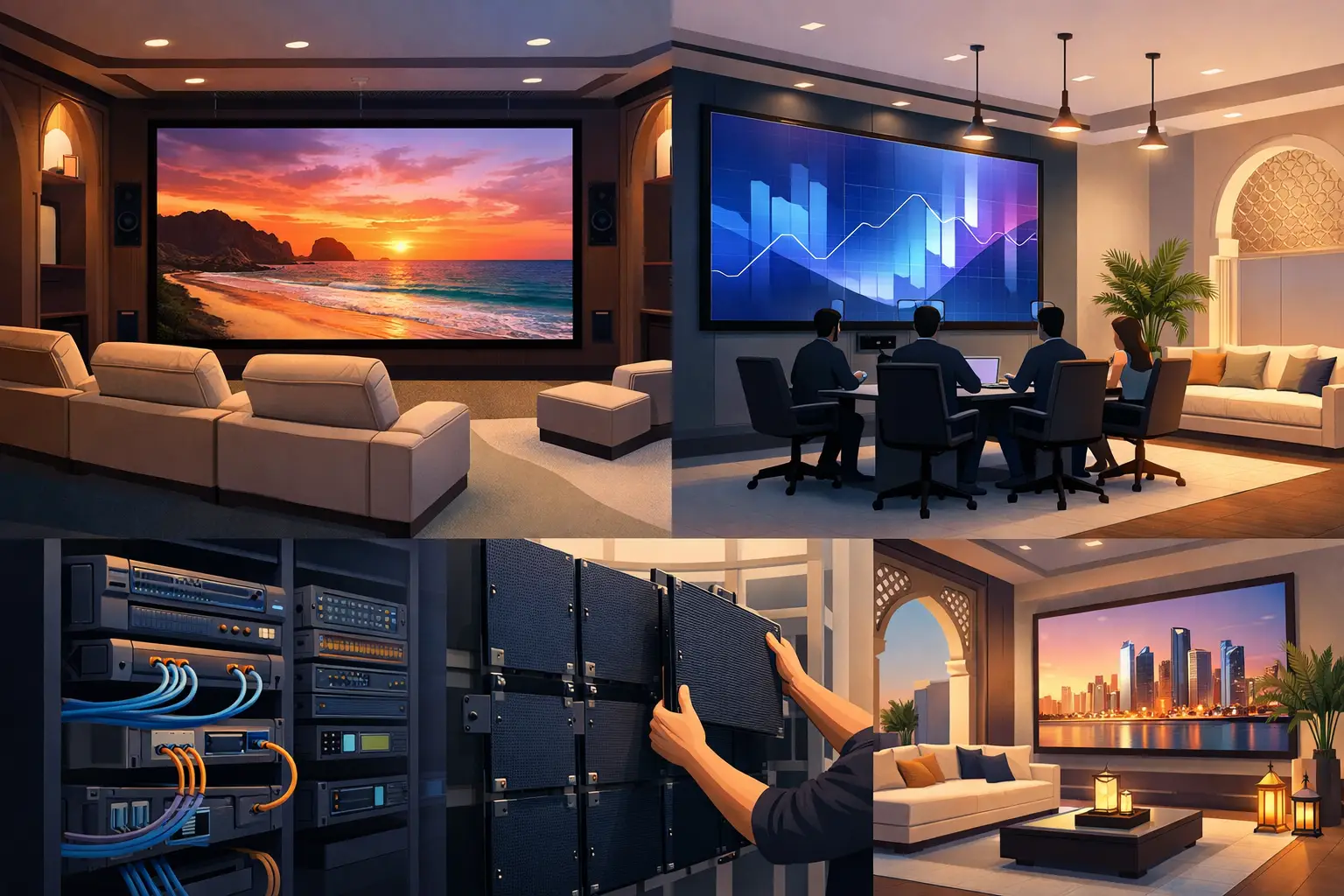
Indoor LED is often selected when a project needs scale, brightness control, flexible sizing, and long-term commercial durability. In reception areas, it creates a strong visual focal point for corporate messaging or brand presentation. In meeting spaces, it supports presentations and hybrid collaboration with better visibility than many projection systems. In retail and hospitality, it is used for advertising, wayfinding, promotions, and digital ambience. In premium residential applications, it can serve private cinema rooms, entertainment spaces, or large-format media walls where clients want impact without the limitations of a conventional flat panel.
That said, LED is not automatically the right answer in every room. Fine-pitch LED performs extremely well indoors, but cost, pixel pitch, ambient light, content type, and viewing distance all need to be weighed carefully. In a small boardroom with viewers seated very close to the display, a high-quality commercial display may still be the more practical option. In a large atrium or open reception, LED often becomes the stronger long-term choice.
What actually defines a good indoor LED screen solution
A good system starts with application clarity. Is the screen primarily for branding, live presentations, digital signage, broadcast feeds, entertainment, or mixed use? Each use case changes the specification. Presentation-heavy environments need accurate text rendering and straightforward source switching. Branding walls may prioritize form factor, edge alignment, and color consistency. Entertainment spaces place more emphasis on contrast, image processing, and audio integration.
Pixel pitch is usually the first technical decision clients hear about, and for good reason. It directly affects image sharpness at a given distance. A tighter pixel pitch is better for close viewing, but it also increases cost. There is no benefit in over-specifying pitch for a screen viewed mostly from a long distance. The right choice comes from matching screen resolution and cabinet layout to the real audience position, not the most aggressive specification on paper.
Brightness and contrast also need balance. Indoor screens do not require the excessive light output associated with outdoor displays, but they still need to perform under the actual ambient lighting conditions of the space. Glare from glass facades, decorative lighting, and reflective finishes can change what looks acceptable during a demonstration into something difficult to read after installation.
Then there is processing and control. The LED wall is only one layer. The video processor, content player, control interface, signal distribution, and network architecture determine how easy the system is to operate every day. If multiple users need access, or if the screen must switch between signage, presentations, and live sources, the control logic should be planned with the same care as the display itself.
Design and engineering come before product selection
This is where many projects go off track. Clients are often shown cabinet options and pricing before anyone has confirmed structural conditions, access requirements, ventilation, power availability, or service clearances. Indoor LED walls may look clean and minimal from the front, but the support structure and backend infrastructure require proper engineering.
Wall condition matters. A direct wall-mounted installation may be possible in one space and completely unsuitable in another. Recessed installations need civil coordination and exact dimensional planning. Freestanding or feature-wall designs may require custom steelwork and early alignment with interior finishes. If maintenance access is not addressed upfront, a simple future repair can become disruptive and costly.
Power and data planning are equally important. The screen must be integrated into the broader electrical and network design, especially in commercial and institutional environments where uptime and control reliability matter. Heat management, cable routing, redundancy expectations, and rack space for processing equipment all influence the final system performance.
For that reason, indoor LED screen solutions should be treated as engineered systems, not packaged display products. Consultancy, system design, procurement, installation, commissioning, and operator training all affect the result.
Content quality can make or break the investment
An excellent LED wall will still underperform if the content strategy is weak. This is common in reception areas and retail spaces where clients invest heavily in hardware but underestimate what the screen will actually display day to day.
Content must match the screen resolution, aspect ratio, and purpose. Fine text, motion graphics, corporate videos, live dashboards, and promotional loops all place different demands on the display pipeline. If content is stretched, poorly formatted, or updated inconsistently, the screen quickly loses impact.
Operational workflow matters just as much. Who updates the content? How often? From which system? Is there approval control for multiple departments? Does the client need a simple signage platform, scheduled playback, input from external devices, or integration with room control and automation systems? These questions should be answered before handover, not after frustration sets in.
Indoor LED screen solutions for different environments
In corporate spaces, the priority is usually clarity, reliability, and fast operation. Executive briefing rooms, conference facilities, and reception areas benefit from systems that support clean switching between laptops, video conferencing platforms, and scheduled corporate messaging. The best installations keep the user experience simple even when the backend is technically complex.
In hospitality, flexibility is often more valuable than raw specification. Hotels, event venues, and restaurants may need the same screen to support branded content, live events, menus, promotional material, and temporary campaigns. Here, ease of control and rapid content changes are often more important than chasing the highest possible technical specification.
In retail, image consistency and viewing angles become critical. LED walls are used to attract attention, but they must also support the brand environment. Poor calibration, visible cabinet mismatch, or awkward scaling can undermine the space rather than improve it. Retail clients usually benefit from a tighter integration between display design, content planning, and store fit-out.
In luxury residential spaces, clients typically expect visual performance without visible technical compromise. That means careful consideration of room aesthetics, acoustic coordination, source integration, lighting conditions, and control simplicity. A large LED display in a private cinema or entertainment room needs to feel intentional and refined, not like a commercial installation brought into a home.
Why installation and commissioning matter as much as specification
A screen may look correct on a data sheet and still disappoint after installation. Cabinet alignment, flatness, calibration, signal synchronization, and thermal performance all affect the final viewing experience. Even small installation errors become obvious on large-format LED surfaces.
Commissioning is where the system is tuned for real use. This includes image adjustment, processor setup, source testing, content verification, control programming, and user handover. It should also include client training. A well-commissioned LED system reduces support calls because operators understand how to switch sources, manage content, and respond to common issues without guesswork.
Long-term service planning should not be overlooked. Commercial and institutional buyers are usually better served by a provider that can support the system after handover, not just deliver hardware. Spare parts strategy, maintenance access, software updates, and fault response all affect lifecycle cost.
Choosing the right integration partner
When evaluating indoor LED screen solutions, the real question is not only which display to buy. It is who will take responsibility for the full system. That includes room assessment, specification, engineering, mounting method, signal flow, control integration, installation quality, testing, training, and after-sales support.
For projects in Qatar, that integrated approach is especially valuable because many LED installations sit inside broader fit-out, MEP, networking, and AV scopes. Coordination between trades is not optional. It is the difference between a screen that works as intended on day one and a screen that becomes a site issue.
High End Electronics approaches LED projects the same way it approaches wider AV integration – as complete environments that need design discipline, execution control, and accountability through commissioning and support.
If you are planning an LED screen for a commercial space, hospitality venue, institution, or private residence, start with the outcome you need the screen to deliver. The right system usually becomes clear once the room, the users, and the operating model are defined properly.