
Blog
أنظمة فيديو وول في قطر للمشاريع الاحترافية

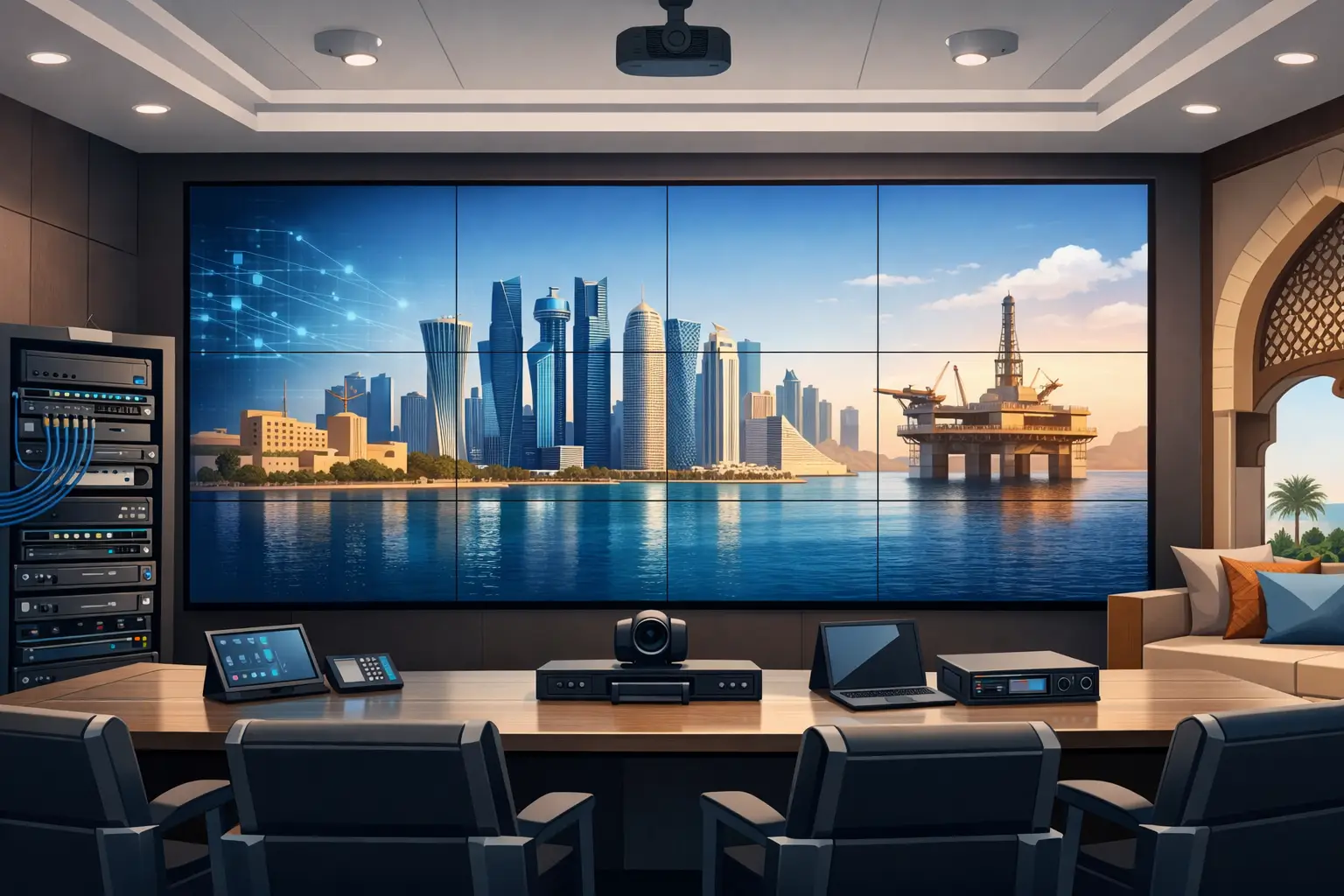
A video wall is often judged in the first few seconds: Is the image clear, properly scaled, and visible from where people actually stand? For teams evaluating أنظمة فيديو وول في قطر, that visible result is only one part of the project. The long-term success of a wall depends on engineering decisions behind the display, including signal distribution, structural mounting, power capacity, cooling, control, content workflow, and access for maintenance.
For a hotel lobby, a corporate reception area, a command center, a showroom, or a public venue, the objective is not simply to install a large screen. It is to create a dependable visual platform that supports daily operations without placing unnecessary demands on facilities teams. That requires a complete integration approach from consultation through commissioning and support.
What a video wall must accomplish
A video wall should be specified according to its operational purpose. A reception wall may display branding, schedules, event information, and promotional content. A control room may require multiple live sources, dashboards, camera feeds, and detailed data that must remain legible for extended periods. A retail or hospitality installation may need strong visual impact under bright ambient light while running scheduled content for many hours each day.
These use cases affect every technical choice. A screen that looks impressive at close range may be excessive for viewers standing 20 feet away. A display selected for short presentations may not be suitable for continuous operation. Likewise, a wall designed only around a single media player can become restrictive when the client later needs live TV, digital signage, meeting room content, or security feeds.
The specification should therefore begin with a practical brief: who will view the wall, from what distance, under what lighting conditions, for how many hours per day, and with which content sources. This process prevents common issues such as oversized pixels, insufficient brightness, poor source switching, and inaccessible equipment locations.
LED and LCD video walls serve different needs
The decision between direct-view LED and commercial LCD displays is not a matter of one technology being universally better. Both can be the right solution when selected for the correct environment.
Direct-view LED for scale and visual continuity
LED video walls are commonly selected for large-format applications, high-brightness areas, and installations where the absence of bezels matters. They can create a continuous canvas for architectural spaces, large meeting venues, control centers, retail environments, and outdoor-facing locations.
Pixel pitch is a critical consideration. A smaller pixel pitch provides higher image detail at closer viewing distances, but it also increases project cost. Selecting an ultra-fine pitch for a wall viewed primarily from across a lobby may not provide meaningful benefit. Conversely, choosing a coarse pitch for a close-viewing environment can make text and graphics appear fragmented.
LED projects also require careful attention to cabinet alignment, front or rear service access, controller configuration, heat management, and calibrated color performance. The visible surface is only as good as the supporting structure and commissioning process behind it.
LCD video walls for detailed indoor viewing
Commercial LCD video wall displays remain a practical choice for indoor spaces where detailed content, controlled lighting, and predictable viewing distances are priorities. Their narrow bezels create a multi-screen display surface suitable for operations rooms, meeting environments, surveillance applications, and information displays.
LCD walls can offer strong image consistency and fine detail, particularly for desktop-style content and data visualization. However, bezel lines remain visible, even when they are minimal. They are also best planned as a system of individual displays, each with mounting, power, network, and signal requirements.
The right decision depends on the viewing experience, operating schedule, budget, architecture, and future expansion plans. A professional site survey and design review are more reliable than selecting a technology based on showroom appearance alone.
Designing video wall systems in Qatar
The environment around the wall matters as much as the display technology. Video wall systems in Qatar must account for high ambient light in glass-fronted spaces, elevated cooling requirements, equipment room conditions, and the operational demands of commercial properties and hospitality venues.
Brightness should be matched to the actual space rather than treated as a headline specification. A display in a shaded boardroom has different needs from one facing daylight in a hotel entrance or retail frontage. Excessive brightness can be uncomfortable indoors and may increase power consumption, while insufficient brightness can leave content washed out at key times of day.
Power planning must also be completed early. Large walls can require dedicated electrical circuits, properly sized distribution, grounding, and backup considerations where continuous operation is essential. Network infrastructure should be planned alongside the wall, especially when using digital signage platforms, remote monitoring, IP-based source distribution, or centralized control.
Facilities access is another decisive factor. A wall that cannot be serviced without dismantling architectural finishes creates unnecessary downtime and cost. Front-service LED cabinets may be appropriate where rear access is impossible. In other projects, a rear technical corridor or service space can simplify maintenance and allow more flexibility in product selection.
Content, sources, and control determine daily value
A video wall is not complete when the panels are powered on. The operational experience depends on how easily users can display the right content at the right time.
A well-designed system can combine scheduled signage, local media playback, live television, presentation sources, video conferencing feeds, CCTV streams, and operational dashboards. A video wall controller or processing platform manages how those sources appear across the canvas, whether as one large image, multiple independent windows, or preconfigured layouts for specific events.
For a corporate environment, a simple touch panel may allow staff to select presentation layouts without technical assistance. In a hospitality setting, a content management platform may schedule promotions by time, location, or event. In a command environment, operators may need secure, immediate access to multiple sources with priority layouts and failover behavior.
The interface should match the people using it. Overcomplicated control systems are often ignored, while overly basic systems can limit the wall’s business value. User training at handover is therefore not an optional final step. It is part of making the installation usable from day one.
Installation quality protects the investment
Video walls combine structural, electrical, IT, AV, and finishing requirements. Fragmenting these responsibilities across unrelated contractors can create avoidable coordination problems, especially when the wall is integrated with architectural cladding, meeting room technology, content infrastructure, or centralized building systems.
A turnkey delivery process brings the critical stages under one accountable scope. It starts with consultancy and site assessment, followed by system design, equipment selection, engineering drawings, supply, installation, configuration, testing, commissioning, and training. Documentation should record equipment locations, wiring routes, signal paths, network settings, and operating procedures so future support does not depend on guesswork.
During commissioning, the integrator should verify more than image quality. Testing should cover source switching, signal stability, display calibration, control functions, scheduled content, network connectivity, thermal performance, and recovery behavior after a power interruption. For mission-critical sites, redundancy and monitoring requirements should be addressed during design rather than added after a failure occurs.
Plan for service before selecting the display
The lowest initial price does not always produce the lowest ownership cost. A wall that is difficult to access, unsupported locally, poorly documented, or dependent on obsolete hardware can become expensive well before the display reaches the end of its expected life.
Service planning should include spare component strategy, warranty coverage, response expectations, remote support capability, and the availability of replacement modules or displays. It should also consider how content and control systems will be maintained as staff, branding, and operational requirements change.
High End Electronics approaches video wall projects as integrated systems rather than standalone display purchases. That means coordinating the display with the infrastructure that makes it functional: mounting, signal management, control, networking, content delivery, commissioning, and after-sales support.
The most effective video wall is not necessarily the largest or the highest-resolution model on a specification sheet. It is the one that remains clear, controllable, serviceable, and relevant to the people who depend on it every day.