
Blog
LED Wall vs Projector: Which Fits Best?

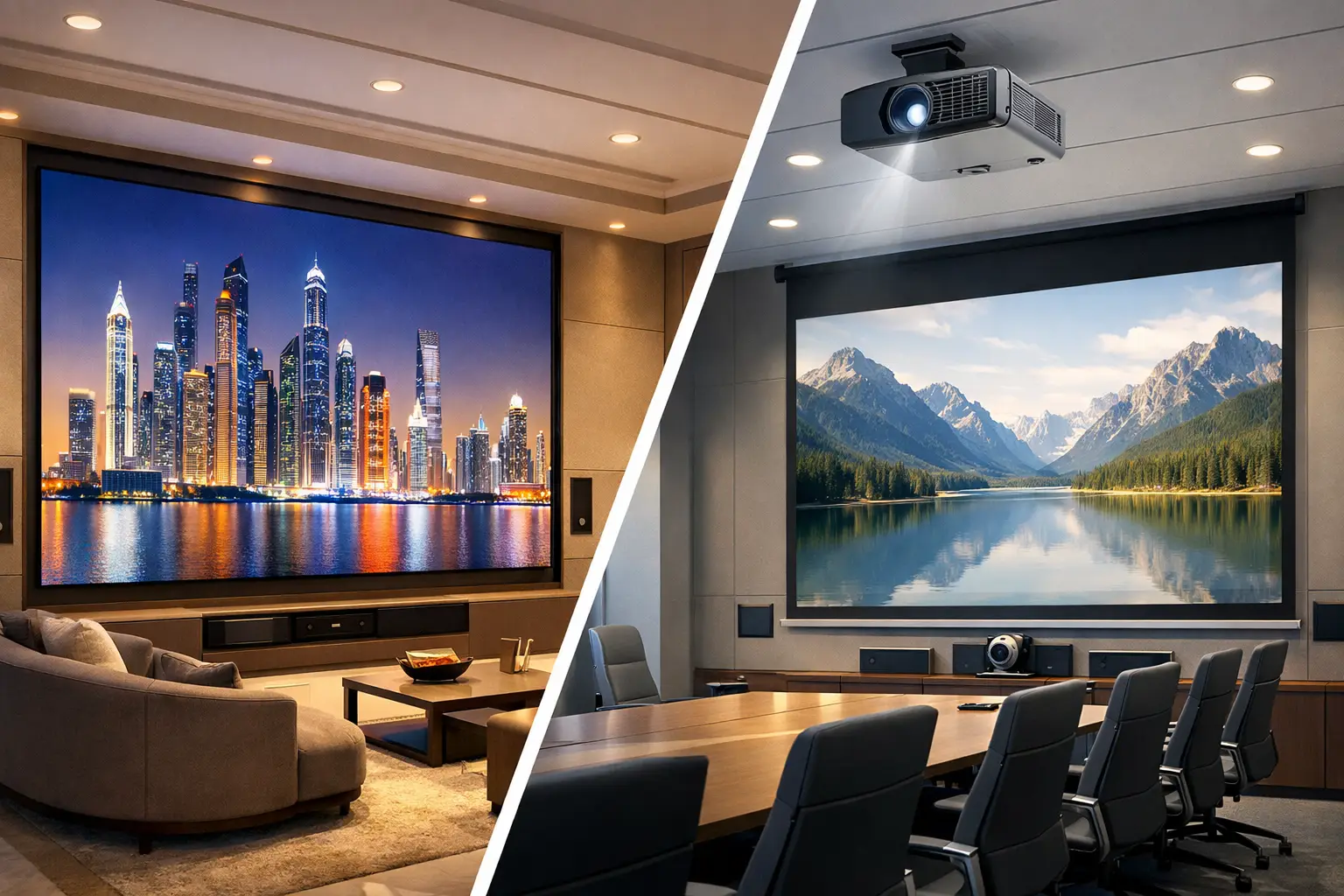
When a client asks about led wall vs projector, the real question is usually not which technology is better. It is which one will perform reliably in the actual room, for the actual audience, and for the way the system will be used over time. A boardroom that runs presentations all day, a hotel ballroom with changing ambient light, and a private cinema built for controlled viewing conditions will not arrive at the same answer.
That is why this decision should be treated as a system design issue, not just a display purchase. Screen size, viewing distance, room lighting, mounting constraints, operating hours, signal distribution, audio integration, and maintenance access all affect the right outcome.
LED wall vs projector: the core difference
An LED wall is a direct-view display. The image is produced by the screen itself, using LED modules assembled into a larger canvas. A projector works differently. It throws light onto a separate surface, and the final image depends heavily on that surface and the surrounding room conditions.
This distinction changes almost everything. LED walls are generally stronger in bright spaces, digital signage environments, and large-format installations where impact and visibility matter. Projectors remain highly effective where a very large image is needed in a controlled space, especially when the visual objective is cinematic rather than purely high brightness.
For many commercial projects, the first deciding factor is ambient light. If the room cannot be darkened consistently, a projector starts at a disadvantage. If the room can be controlled and the content is presentation-based or cinema-focused, projection may still be the more practical choice.
Brightness and room conditions
Brightness is where many comparisons become too simplistic. It is easy to say LED is brighter, but the useful question is how much brightness the room actually demands. In a conference room with glass walls, decorative lighting, and daytime use, an LED wall will maintain image clarity far more effectively than most projectors. Text stays readable, colors hold up better, and the system does not depend on blackout conditions.
A projector can still work well in meeting spaces, but it requires more discipline in room design. Window treatment, lighting control, screen material, and projector placement all need to be coordinated. If those variables are neglected, image performance will suffer, no matter how good the projector is on paper.
In hospitality venues, this becomes even more important. Multi-purpose spaces often shift from conferences to banquets to events, and lighting conditions are rarely fixed. An LED wall gives operators more flexibility because the display remains usable across more scenarios without repeated environmental adjustment.
Image size, resolution, and viewing distance
Both technologies can produce large images, but they scale differently. A projector can create a very large picture at a relatively low hardware cost, which is one reason it remains attractive for auditoriums, classrooms, and home theaters. The trade-off is that image quality depends on projector brightness, lens quality, throw distance, and screen performance.
With an LED wall, image size increases by adding cabinets or modules. That modular approach is powerful, especially for custom aspect ratios or architectural integration, but pixel pitch becomes a critical factor. A large LED display viewed from too close can reveal pixel structure. That means the ideal solution depends on how near the audience will stand or sit.
In a reception area or event hall where viewers are several meters away, a larger pixel pitch may be acceptable. In a boardroom or premium residential setting where people are closer to the display, finer pitch is required, and that affects budget. This is one of the most common mistakes in early-stage planning – comparing display size without matching it to viewing distance.
Visual quality and content type
If the primary use is spreadsheets, dashboards, presentations, and digital signage, LED often has the advantage in perceived clarity under real operating conditions. The image is punchy, readable, and less vulnerable to washout.
If the goal is film viewing in a purpose-built home theater or private cinema, projection still has a very strong case. A well-designed projection system can deliver a scale and viewing experience that many clients prefer for cinematic content. The image feels natural in dark-room viewing, and the room can be designed around the screen, acoustics, and seating geometry.
That said, premium LED solutions are increasingly entering high-end residential projects where clients want large images without lamp dimming concerns, without projection shadows, and without dependence on full blackout. The answer is no longer fixed by category alone. It depends on whether the room is optimized for cinema or needs to serve multiple functions.
Space planning and installation constraints
A projector may look simpler at first, but installation is not always easy. Throw distance, ceiling structure, lens alignment, cable routing, ventilation, and maintenance access all need attention. Ultra-short-throw models can reduce distance requirements, but they introduce their own placement sensitivities.
An LED wall removes some of those issues and introduces others. It does not require projection distance, which is useful in shallow rooms. It also avoids people walking through the light path. However, the wall structure, power distribution, control equipment, heat management, and service access need proper engineering.
In commercial fit-outs, this matters because the display rarely exists in isolation. It must coordinate with joinery, wall finishes, room booking systems, conferencing platforms, switching equipment, and sometimes video distribution across multiple spaces. In that environment, the display choice should support the overall system, not complicate it.
Maintenance, uptime, and lifecycle thinking
For decision-makers responsible for continuous operation, lifecycle matters as much as initial image quality. Projectors can require lamp or light-source maintenance, filter attention in some models, periodic recalibration, and more sensitivity to dust and environmental conditions. Laser projectors have improved this significantly, but they still operate as optical systems with performance variables that must be managed.
LED walls are generally chosen when uptime and consistent performance are priorities. In many applications, they offer better day-to-day operational stability, especially in long-running commercial use. Still, they are not maintenance-free. Module replacement, calibration consistency, controller configuration, and front or rear service planning must be addressed from the start.
This is where an integration-led approach has real value. The best result comes from planning not only what gets installed, but how it will be serviced, who will operate it, and how quickly issues can be resolved without disrupting the space.
Cost is more than the purchase price
The cost discussion around led wall vs projector often gets reduced to a simple statement that projectors are cheaper. That can be true at entry level and even across some mid-range large-screen applications. But for professional environments, total cost should include room modifications, control requirements, service intervals, operating hours, brightness expectations, and replacement cycles.
A projector may have a lower initial hardware cost, but if the room needs blackout treatment, specialty screens, ceiling rework, and recurring maintenance, the gap narrows. An LED wall usually requires higher upfront investment, especially with fine pixel pitch, but it can deliver stronger long-term value in high-usage environments where visibility and operational consistency matter every day.
For institutional or commercial buyers, the right comparison is not display price against display price. It is solution cost against operational requirement.
Which option fits which environment?
In boardrooms, control rooms, reception spaces, retail environments, and hospitality venues with variable lighting, LED is often the stronger answer. It performs consistently, supports long operating hours, and handles visual impact well.
In auditoriums, training spaces, and purpose-built theaters where large image size is needed in controlled lighting, projection remains highly relevant. In premium residential projects, the choice is more nuanced. A dedicated cinema room often favors projection, while a multi-use entertainment space may benefit from LED.
For clients in Qatar, where bright daytime conditions and glass-heavy architecture are common, ambient light control should be evaluated early. In many modern spaces, that single factor changes the recommendation quickly.
The best display decision is usually made before procurement, at the design stage, when room conditions, audience behavior, infrastructure, and content strategy can be assessed together. A display should not simply fit the wall. It should fit the way the space actually works, and continue doing so long after handover.