
Blog
Structured Cabling Installation Services

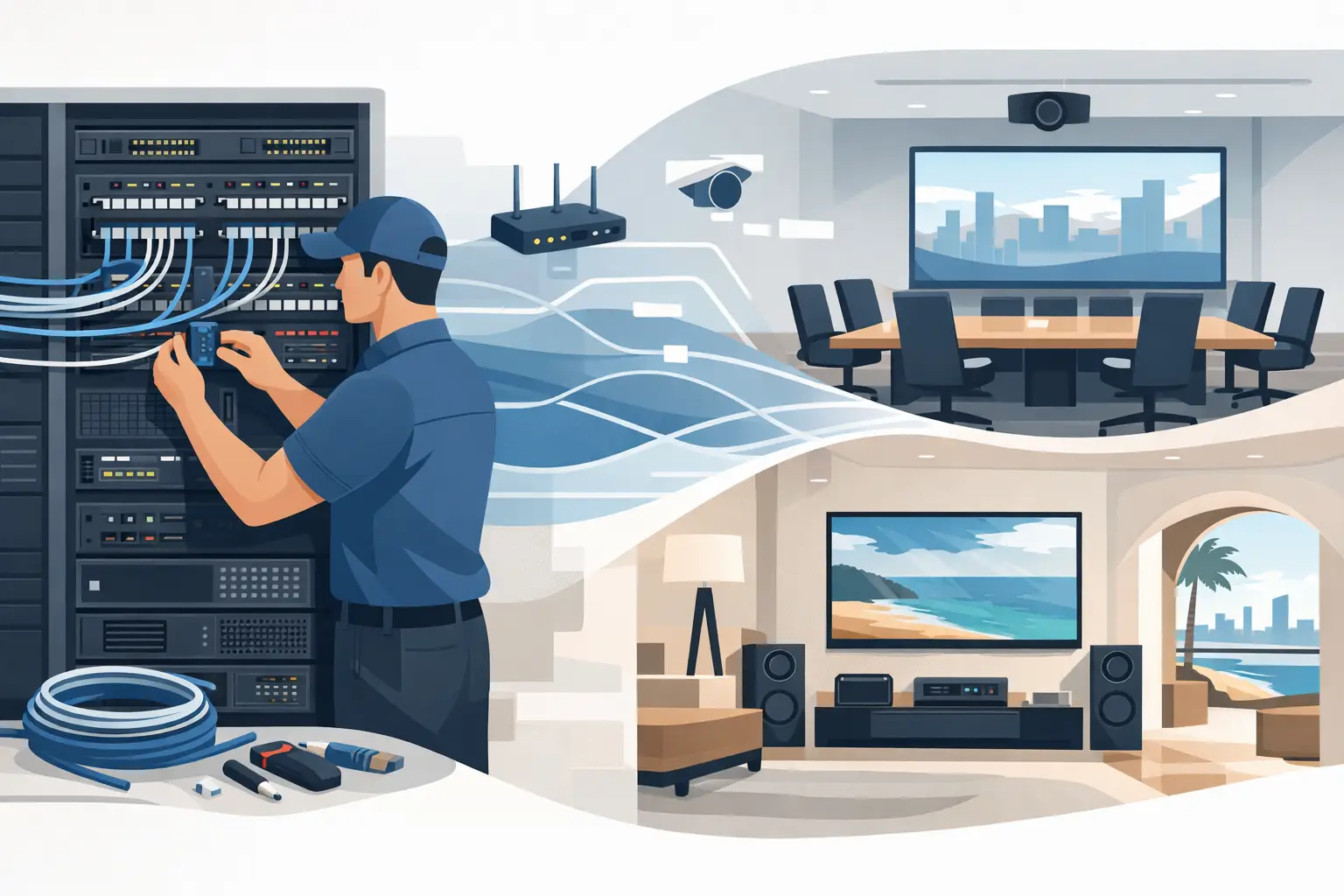
A network rarely fails all at once. More often, the warning signs show up first – dropped calls in a meeting room, patchy Wi-Fi in one wing, cameras losing connection, IPTV glitches, or a workstation that never seems to get full speed. In many of these cases, the problem is not the active equipment. It is the physical layer. Structured cabling installation services address that foundation by giving voice, data, AV, control, and wireless systems an organized infrastructure built for performance and future changes.
For developers, facility managers, hospitality operators, and homeowners planning premium technology environments, cabling is not a side trade to be handled late in the project. It affects reliability, maintenance access, expansion capacity, and how well multiple systems work together over time. When the cabling is designed and installed correctly, every connected system has a better chance of performing as intended.
What structured cabling installation services actually cover
Structured cabling is the planned design and installation of low-voltage cabling and connectivity hardware in a standardized layout. That usually includes copper data cabling, fiber optic backbones, patch panels, racks, faceplates, outlets, containment pathways, labeling, testing, and documentation. Depending on the project, it may also support wireless access points, IP telephony, CCTV, access control, IPTV, digital signage, and integrated AV systems.
The key distinction is structure. Instead of running one-off cables for each immediate need, the system is organized into zones, pathways, terminations, and distribution points that support both current use and future moves, adds, and changes. This matters in offices, hotels, schools, villas, and mixed-use properties where technology demands rarely stay fixed for long.
A well-executed cabling project also depends on coordination. Cable routes must align with architectural constraints, MEP services, equipment locations, rack layouts, and final device counts. If these elements are not coordinated early, the result is usually rework, visible patch fixes, or capacity limits that appear as soon as the site becomes operational.
Why structured cabling installation services matter more than most clients expect
Most decision-makers focus first on visible endpoints – displays, access points, phones, cameras, switches, and control interfaces. Those are important, but they only perform as well as the underlying cabling allows. A high-spec switch cannot compensate for poor termination quality, excessive bend radius, overloaded pathways, undocumented patching, or inconsistent labeling.
This is where the value of structured cabling becomes practical rather than theoretical. A properly installed cabling system reduces troubleshooting time because technicians can identify routes and endpoints quickly. It supports cleaner commissioning because connected systems are easier to test. It also lowers disruption during expansions because spare capacity, rack organization, and documentation have already been considered.
There is also a lifecycle cost issue. Low initial pricing can look attractive when cabling is treated as a commodity, but poorly planned installation often creates hidden expense later through downtime, tracing labor, premature upgrades, and tenant disruption. In active commercial and hospitality environments, those downstream costs can exceed any initial savings.
Design comes before cable pulling
The quality of a cabling installation is largely decided before the first cable is pulled. Good design starts with a clear understanding of system requirements, room functions, density, equipment locations, and service expectations. A conference room, for example, may need more than data outlets. It may also require cabling for displays, video conferencing, control, scheduling panels, wireless presentation, and ceiling microphones. A hotel may need structured support for guest connectivity, IPTV, telephony, back-office systems, surveillance, and building operations.
This is why structured cabling should not be designed in isolation. It works best when planned as part of the wider technology environment. In integrated projects, cabling has to support not only network traffic but also the practical needs of AV systems, wireless coverage, centralized equipment rooms, and maintenance access.
There are trade-offs. Overdesign can increase cost unnecessarily, while underdesign usually leads to difficult retrofits. The right balance depends on the property type, expected occupancy, service model, and upgrade horizon. In a premium residence, flexibility for future smart automation and media distribution may matter more than high workstation density. In a commercial fit-out, port count, redundancy, and rack space often take priority.
Copper, fiber, and the question of scale
Not every site needs the same media mix. Copper cabling remains the standard for many endpoint connections because it is cost-effective and practical for common device runs. Fiber becomes increasingly important in larger sites, campus environments, high-bandwidth backbones, and situations where longer distances or electromagnetic considerations apply.
Choosing between them is not always either-or. Many projects need both, with fiber linking key distribution points and copper serving local endpoints. The right decision should come from bandwidth planning, distance calculations, rack topology, and future growth, not habit.
Pathways and containment are part of performance
Cabling quality is not only about cable category. Pathways, containment, separation from electrical services, access to ceiling voids, and rack ventilation all affect long-term reliability. A project can use good materials and still underperform if cable routing is congested, unsupported, or exposed to conditions that make future service difficult.
Neat containment also has an operational benefit. Technicians can work faster and with less disruption when routes are accessible and clearly organized. That matters in live facilities where downtime has a direct business impact.
What a professional installation process should look like
A competent structured cabling contractor should deliver more than labor. The process should begin with site evaluation and technical coordination, followed by shop drawings, pathway planning, material selection, and phased installation aligned with the construction schedule.
During installation, workmanship standards matter. Cable pull tension, bend radius, termination consistency, rack dressing, outlet positioning, and labeling all affect both certification results and maintainability. This is not cosmetic. Clean rack builds and logical patching reduce service time later and help other systems integrators complete commissioning without avoidable delays.
Testing is another point where quality becomes visible. Every installed link should be tested to the relevant standard, with results documented clearly. Without test records, it is difficult to prove that the installed infrastructure meets performance expectations. Documentation should also include as-built information, labeling schedules, rack elevations where applicable, and endpoint identification. These records save time long after handover.
Structured cabling in integrated environments
In modern projects, structured cabling often sits at the center of a larger technology ecosystem. Video walls, meeting room systems, wireless networks, IPTV, guest room controls, access control, and IP telephony may all depend on the same cabling framework. That creates efficiency, but it also raises the bar for design accuracy and installation discipline.
This is why many clients prefer a partner that understands the full system context rather than a standalone cable installer. When the same project team can coordinate AV, networking, telephony, and control requirements, there is less risk of duplicated pathways, missed outlets, undersized racks, or incompatible room layouts. High End Electronics approaches projects this way, treating structured cabling as part of the full technology delivery chain rather than a disconnected package.
For clients in Qatar, this integrated model is especially useful on complex villas, hospitality properties, institutions, and commercial spaces where multiple stakeholders are involved and site coordination directly affects timelines.
How to evaluate structured cabling installation services
The right provider should be judged on execution capacity, not just cable pricing. Experience with similar property types matters because design assumptions differ between a private cinema villa, a corporate office floor, and a hospitality site. Coordination capability matters because cabling intersects with architecture, electrical, HVAC, joinery, and specialist systems. Support after handover matters because documentation, testing records, and service response determine how manageable the infrastructure will be over the years.
Ask practical questions. Who prepares the design and shop drawings? How are rack layouts coordinated? What testing will be performed? Will as-built documentation be delivered? Can the provider support connected systems after installation, or does responsibility stop at the patch panel?
These questions usually reveal whether a contractor sees cabling as a commodity or as infrastructure with operational consequences.
The long-term value is clarity
The best structured cabling installations are not noticed day to day. Systems connect quickly, faults are easier to isolate, expansions are less disruptive, and equipment rooms stay understandable long after the original project team has left. That kind of clarity is not accidental. It comes from disciplined design, careful installation, thorough testing, and complete project responsibility.
If a building is expected to support communication, media, automation, and networked operations for years, the physical layer deserves the same attention as the devices connected to it. Cabling is one of the few technology investments that touches everything else, which is exactly why it should be planned with care from the start.