
Blog
8 AV Over IP Trends Shaping System Design

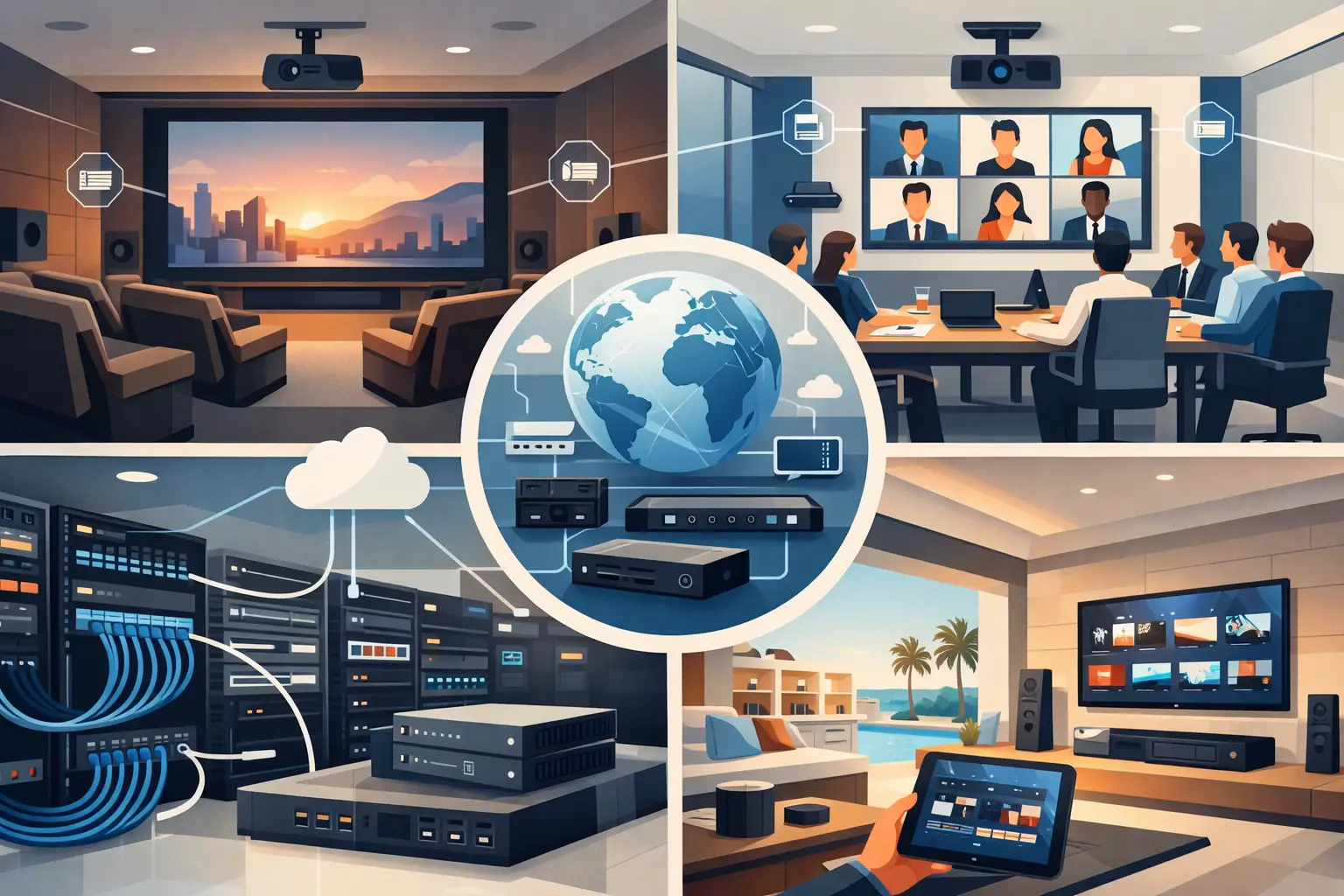
A conference room that worked well five years ago can feel outdated the moment users expect 4K distribution, soft codec integration, centralized control, and easy expansion without rewiring the entire floor. That is exactly why av over ip trends matter now. They are not just changing transport methods. They are changing how systems are designed, commissioned, secured, and supported over their full lifecycle.
For developers, facility teams, hospitality operators, and private clients, the shift is practical. AV is no longer an isolated layer built around point-to-point switching. It now sits much closer to the IT environment, where bandwidth, network policy, cybersecurity, and device management all affect performance. That creates more flexibility, but it also raises the standard for design and execution.
Why AV over IP trends are changing project requirements
Traditional matrix-based AV distribution still has a place in some projects, especially where scale is limited and the signal path is fixed. But many new projects require more than source-to-display routing. They need video distribution across multiple zones, remote monitoring, flexible room combinations, digital signage support, and the ability to add endpoints later without replacing the core platform.
AV over IP supports that model because endpoints can be added, grouped, and managed through the network infrastructure. In a corporate office, that may mean extending content distribution across meeting rooms, training spaces, and executive areas. In hospitality, it may mean serving guest-facing displays, event spaces, and back-of-house monitoring from one structured platform. In a high-end residence, it may support whole-property video distribution alongside control and network services.
The key point is that the network becomes part of the AV architecture. That is where current trends are most significant.
1. Network-aware AV design is replacing isolated AV planning
One of the clearest av over ip trends is that AV design now starts with the network conversation, not after it. VLAN strategy, multicast handling, switch backplane capacity, PoE budgets, and uplink planning are no longer details left for late-stage coordination. They directly affect whether the system performs as specified.
This is a positive shift, but only when it is managed correctly. AV teams and IT teams often use different assumptions. AV priorities focus on signal integrity, latency, and user experience. IT priorities focus on security, standardization, and maintainability. Projects succeed when both are addressed early in consultancy and design.
For integrators, this means producing designs that account for traffic profiles, endpoint density, switch configuration, and future growth from the start. For clients, it means choosing a delivery partner that can coordinate these disciplines rather than pushing responsibility between vendors.
2. 1GbE and 10GbE decisions are becoming more strategic
Not every AV over IP system belongs on a 10GbE backbone, and not every project can be served well by 1GbE compression-based transport. The trend is not simply toward more bandwidth. It is toward selecting transport architecture based on content type, latency tolerance, image expectations, and scale.
In many commercial environments, 1GbE platforms remain practical because they balance performance, cost, and switch availability. They are suitable for a wide range of meeting room and signage applications where visually lossless compression is acceptable. However, when projects demand lower latency, higher image fidelity, or larger channel counts, 10GbE becomes more attractive.
This is where oversimplified advice causes problems. A client may hear that one approach is newer or faster, but the better question is whether it matches the operational use case. A boardroom presentation, a divisible event space, and a private cinema do not place identical demands on transport design.
3. Video is only part of the system now
Earlier AV over IP conversations often centered on video routing. That is no longer enough. Current deployments increasingly combine video, audio, USB extension, control, room scheduling, and platform integration within the same system strategy.
This matters because user expectations have changed. A space is not judged only by whether a display receives signal. It is judged by how quickly a user can start a meeting, connect peripherals, switch sources, join a call, and maintain a consistent experience from room to room.
As a result, AV over IP design is expanding from transport selection into workflow design. Integrators have to think through USB camera extension, microphone DSP behavior, control processor logic, and device interoperability as part of the same environment. The technical stack is broader, and commissioning has to be correspondingly more disciplined.
4. Security is now a front-end discussion
As AV endpoints move onto enterprise and property-wide networks, cybersecurity can no longer be treated as an afterthought. Devices require proper credential management, firmware control, segmentation, and defined access policies. Remote support features also need governance.
This trend is especially relevant in corporate, education, and hospitality environments where network exposure is broader and operational risk is higher. A poorly secured AV device may not only affect presentation systems. It can create an avoidable vulnerability inside the wider infrastructure.
For that reason, experienced integration teams now address security during design, not only during handover. Device selection, network topology, user permissions, and support procedures should all align with the client’s IT policy. There is a trade-off here. More security controls can increase deployment complexity, but that complexity is preferable to unmanaged risk.
5. Centralized management is becoming a core requirement
The more endpoints a system includes, the less practical it becomes to support them manually. One of the strongest AV over IP trends is the rise of centralized monitoring and management as a baseline expectation.
Clients want visibility into device status, offline alerts, thermal conditions, firmware versions, and source-display relationships. Facilities teams want faster fault isolation. Operators want fewer room outages. In managed environments such as hotels, multi-room offices, and institutional sites, centralized oversight improves response time and reduces service disruption.
This also affects project handover. A completed installation is no longer just racks, screens, and cable schedules. It should include a support-ready environment with documented IP schemes, device naming, management access, and escalation procedures. Long-term performance depends on that discipline.
6. Scalability is being judged by operational reality, not just endpoint count
Manufacturers often promote scalability in terms of how many encoders and decoders a platform can support. That metric matters, but it is incomplete. Real scalability depends on how easy the system is to expand without disrupting live operations, retraining users, or rebuilding network policy.
A well-designed AV over IP platform should support phased growth. A client may start with one floor, one villa zone group, or one event venue section and add capacity later. Expansion should be predictable in terms of switch ports, uplinks, control logic, and support overhead.
This is where design experience shows. It is relatively easy to specify a platform that works on day one. It is more valuable to build one that still works cleanly after several rounds of expansion and operational changes.
7. Standards and interoperability are under closer scrutiny
Clients are increasingly cautious about closed ecosystems, especially when projects involve long asset lifecycles. They want confidence that future upgrades, endpoint replacements, and third-party integrations will not force a complete redesign.
That does not mean every open standard is automatically the right choice, or that proprietary systems should always be avoided. Proprietary platforms can offer strong performance and simpler deployment within a controlled environment. The trade-off is potential limitation later if project requirements shift.
For consultants, developers, and owners, the practical question is how much flexibility the project may need over time. A campus rollout, hospitality property, or premium residence with planned future upgrades usually benefits from careful interoperability planning at the beginning.
8. Commissioning quality is becoming the real differentiator
As AV over IP becomes more common, hardware alone is less of a differentiator. The real gap between average and high-performing projects is often found in commissioning quality.
That includes switch configuration, endpoint addressing, multicast behavior, DSP tuning, control logic validation, failover testing, labeling, documentation, and user training. Systems that look similar on a proposal can perform very differently once installed. The difference usually comes down to engineering discipline and accountability during deployment.
This is particularly important in Qatar, where many projects combine premium expectations with demanding timelines and mixed-use building requirements. In these environments, a fragmented delivery model creates avoidable risk. A coordinated approach covering design, supply, installation, commissioning, and post-handover support generally produces a more stable result.
What clients should take from these AV over IP trends
The market is moving toward more flexible, software-aware, network-dependent AV systems. That creates clear advantages, but only when the infrastructure, device ecosystem, and support model are aligned. Choosing AV over IP because it is current is not enough. The design has to match room function, user behavior, IT policy, and future expansion plans.
For some projects, that will mean a fully converged networked AV strategy. For others, a hybrid approach will be smarter, combining conventional switching with IP-based distribution where it adds measurable value. The right answer depends on the building, the use case, and the level of operational support available after commissioning.
The most useful question is not whether AV over IP is the future. It is whether your next system is being designed with the right balance of performance, security, scalability, and serviceability from day one.