
Blog
TV Distribution System for Hotels Explained

A guest may never ask what sits behind the screen in the room, but they notice immediately when channels freeze, picture quality drops, or the welcome interface feels dated. That is why a TV distribution system for hotels is not just an entertainment utility. It is part of the property’s guest experience, operational efficiency, and brand standard.
For hotel owners, operators, and project teams, the real question is not whether to install a distribution platform. It is how to specify one that fits the building, supports current services, and remains manageable after handover. A good system is engineered as infrastructure, not treated as an afterthought added near opening.
What a TV distribution system for hotels actually does
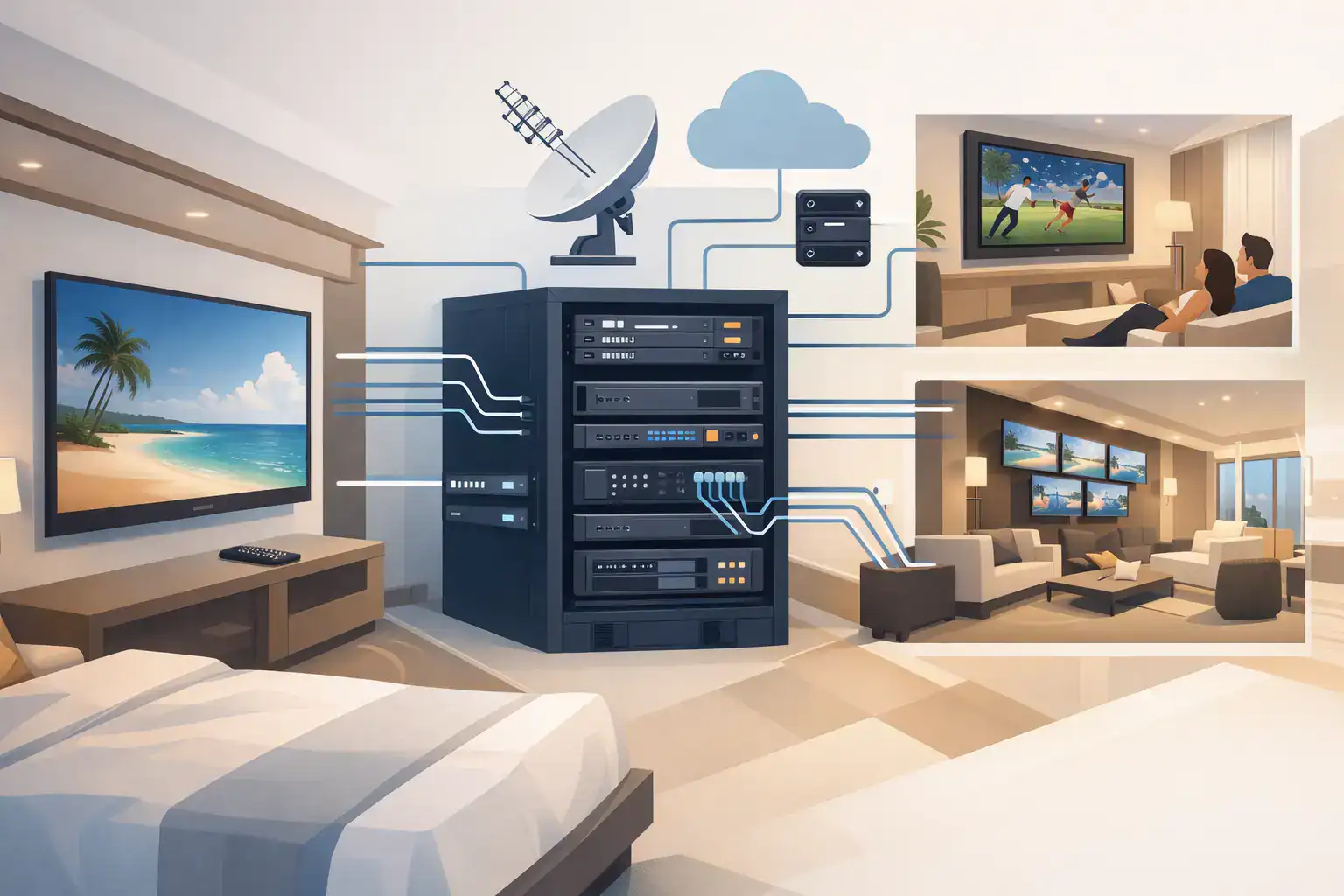
At a practical level, the system takes content from multiple sources and delivers it reliably to guest rooms and shared areas. Those sources may include satellite channels, local broadcast feeds, in-house information channels, digital signage content, promotional media, and on-demand platforms depending on the property model.
The distribution layer has to do more than carry video. In a hotel environment, it often supports channel management, content control, centralized updates, room grouping, and integration with other guest technologies. That can include property management systems, guest room controls, IPTV middleware, and network infrastructure.
This is where project requirements start to separate one hotel from another. A limited-service property may need dependable live TV with a branded information channel and straightforward control. A luxury hotel may require interactive services, multilingual menus, casting options, analytics, and content segmentation across rooms, suites, restaurants, lounges, and meeting spaces.
The main system architectures
Most hotel projects will evaluate either RF-based distribution, IPTV, or a hybrid approach. Each has a valid use case, and the right choice depends on the building and operating model.
RF distribution
RF systems are familiar, cost-conscious, and effective where the scope is centered on live channel delivery. They can work well in properties where the requirement is stable television service without heavy interactivity. In some refurbishment projects, RF can also make use of existing cabling infrastructure, which may reduce disruption and help control costs.
The trade-off is flexibility. RF is typically less capable when the hotel wants advanced user interfaces, detailed content management, personalized guest messaging, or future service expansion through software-driven features.
IPTV distribution
IPTV is usually the stronger option for hotels that want a more modern guest experience and better central control. It allows content to move over the property’s network, which opens the door to interactive portals, customized welcome screens, service promotion, integrated information pages, and more efficient content updates.
That said, IPTV places greater demands on network design. Bandwidth, switching, VLAN strategy, multicast handling, endpoint compatibility, and cybersecurity all matter. If the network is underspecified, the TV experience suffers quickly. IPTV is not just a display decision. It is a systems integration decision.
Hybrid models
In some hotels, a hybrid model makes the most sense. A property may retain part of an existing RF environment while introducing IPTV features in premium rooms or new wings. This can be the right move during phased upgrades, especially when the owner wants to improve guest-facing services without replacing every part of the legacy infrastructure at once.
Why system design matters more than screen count
One common mistake in hotel planning is to focus too early on room TV quantity and screen size while giving less attention to headend design, rack layout, cabling topology, and management requirements. In reality, the backbone determines whether the system performs consistently under load and remains serviceable over time.
A properly designed TV distribution system for hotels starts with source mapping, room typology, and service objectives. Guest rooms, suites, lobbies, restaurants, gyms, spa areas, and meeting rooms often require different content rules and control logic. The design also has to account for equipment room conditions, cable pathways, redundancy expectations, and ongoing maintenance access.
Future planning is equally important. Hotels rarely stand still. Channels change, branding evolves, operators add services, and guest expectations shift toward more connected in-room experiences. A system designed only for day-one operation can become restrictive very quickly.
Key decisions during specification
The most successful projects are usually the ones where technical and operational teams align early. Procurement alone should not drive the specification. The hotel needs to define how television service supports the guest journey and daily operations.
Content source planning comes first. The property needs to confirm whether the channel lineup will rely on satellite, local channels, in-house media, or a managed content platform. Then the team should decide how content will be organized by room type or zone.
The next decision is the level of interactivity. Some hotels only need reliable channel access and a hotel information page. Others want service directories, promotions, language selection, guest messaging, and integration with room status or billing platforms. These are very different system briefs, and they affect middleware, network design, licensing, and support.
Television endpoint compatibility also matters. Not every hospitality display behaves the same way with every control platform or distribution method. Interface standards, commercial display features, remote management capability, and long-term support availability should all be reviewed before procurement is finalized.
Integration with the wider hotel technology stack
Hotel TV systems work best when they are treated as part of a connected platform rather than an isolated package. In many projects, the television layer intersects with structured cabling, switching, wireless infrastructure, digital signage, guest room automation, and sometimes IP telephony and building-wide communications.
This is where integration capability becomes critical. If separate contractors handle network infrastructure, AV systems, and room technology without a coordinated design and commissioning process, small mismatches can create recurring faults. Channel mapping may not align with room control logic. Network settings may conflict with content delivery requirements. User interfaces may be inconsistent across room types.
An integrated delivery model reduces those risks because design responsibility is not fragmented. For hotels in Qatar, where project timelines are often tight and handover expectations are high, that coordination has practical value during installation, testing, and operator training.
Installation and commissioning are not administrative steps
In hospitality projects, installation quality has a direct effect on long-term system stability. Rack organization, labeling, signal balancing, network configuration, and endpoint setup all influence how quickly the system can be maintained after opening.
Commissioning is where many hidden issues should be found and resolved. That includes testing source redundancy, validating channel availability across room groups, checking interface behavior, verifying failover, and confirming that control permissions are correct. It should also include documentation and client training, not just a sign-off sheet.
When a hotel opens with an unfinished or lightly tested TV platform, the operations team ends up carrying the burden. Minor faults become guest complaints, and simple changes require repeated support calls. A commissioned system should be usable, documented, and supportable from day one.
Support after handover
Hotels operate continuously, which means media systems do not have the luxury of extended downtime. Support planning should be part of the original scope, not something discussed only after launch.
That includes access to technical assistance, software updates where applicable, spare parts strategy, and a clear process for fault reporting. It also helps to define who can make routine changes such as channel updates, content replacement, or room grouping adjustments.
This is one reason many operators prefer a provider that can handle consultancy, design, supply, installation, commissioning, training, and after-sales support under one contract. High End Electronics approaches projects from that full-lifecycle perspective because hospitality systems perform better when accountability is clear from design through operation.
What hotel decision-makers should prioritize
If the objective is a dependable guest experience, the best decision is rarely the cheapest hardware package. Decision-makers should prioritize fit-for-purpose architecture, integration with the building’s wider technology environment, ease of operation, and supportability over the life of the property.
The right system may be simple or highly advanced depending on the hotel. What matters is that the design matches the business model. A business hotel, resort, branded residence, and luxury property will not need the same television strategy, even if they use similar displays in the rooms.
A well-planned TV distribution system for hotels should feel invisible to the guest and manageable to the operator. When that balance is achieved, the technology stops being a source of complaints and starts doing what good infrastructure is supposed to do – support the property without demanding attention.
If you are planning a new hotel or upgrading an existing one, treat the TV platform like core building technology. That shift alone usually leads to better decisions, fewer operational surprises, and a system that stays useful long after opening day.